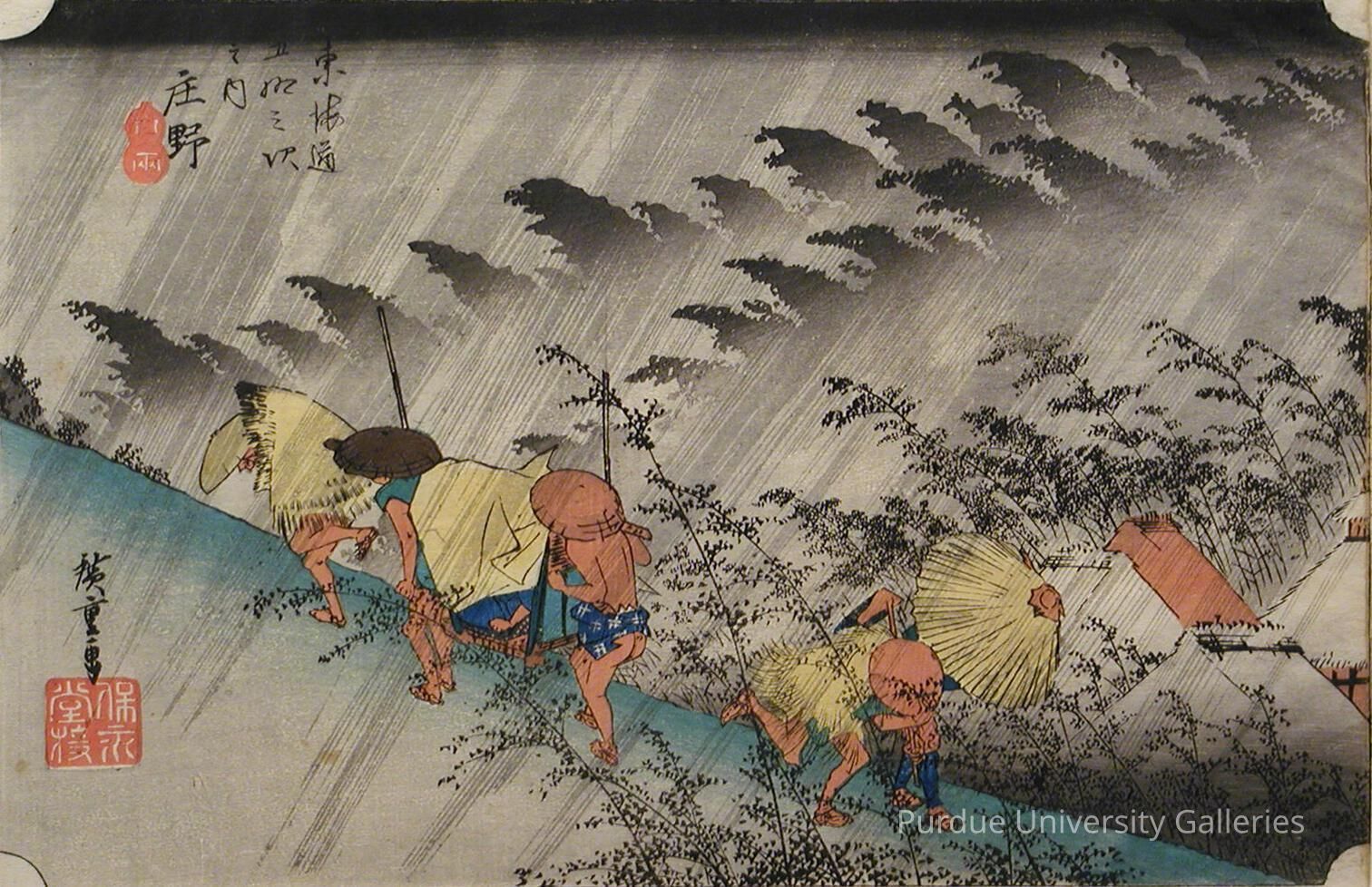
Sudden Rain at Shōno (庄野白雨) from the series Fifty-Three Stations of the Tokaido (東海道五十三次)
1995.12.04
Woodcut
Paperink
1995.12
Edward Stowe Akeley
Courtesy of Edward Stowe Akeley
Utagawa Hiroshige 歌川 広重
Artist
Takenouchi Magohachi 竹内 孫八Hōeidō ban 保永堂版
1833 - 1834
19th Century
Japan
Signature
center left
広重 が [Hiroshige ga]
Japanese
Made by Hiroshige
WrittenInk
Seal
lower left
保永堂 [Hoeidō]
Japanese
Publisher
StampedInk
Publisher seal below artist signature
Woodcut
Print, Relief
Graphic Documents
Documentary Objects
Category 08: Communication Objects
From Akeley's 1995 catalogue
8-7/8 in
13-5/8 in
Source Notes
Information provided by source.
Professor Edward Akeley (1894-1984) and Mrs. Anna Akeley (1904-2004), West Lafayette, IN; donated to Purdue Galleries in 1995.
Shrouds, Masks, And The Floating World: Selections From The Permanent Collection (2009)
Cultural/Historical Context
"Hiroshige shares with Hokusai the reputation of being the foremost landscape artist of Japan. He received his earliest art instruction in the studio of Flinsai, an artist of the Kano school, but on the death of his parents when he was fourteen, he applied for admission to the school of Toyokuni. There was no vacancy for him there so he turned to Toyohiro, who accepted him as a pupil and gave him the artist names of lchiyusai Hiroshige. After the death of Toyohiro, in 1829, he changed the first name to lchiryusai. In 1830, he was commissioned by the Tokugawa Government to go to Kyoto and paint the ceremony of “presenting the horses,” which it was the custom of the Shogun to send to the Emperor every year. Traveling in company with the party in charge of the horses, Hiroshige was impressed by the scenery of the Tokaido, the imperial road linking Edo with Kyoto, and made sketches of each of the fifty- three relay stations along the way. These sketches were published in 1834 and were an immediate success and were followed by other landscape series including Thirty-six Views of Mount Fuji and Sixty-nine Stations on the Kisokaido. Fifty-three Stations of the Tokaido is, however, regarded as Hiroshige’s most famous work. This print represents Station 46 at Shono and is considered the masterpiece of the Tokaido series. -- Ukiyo-e (Pictures of a Floating World) For over two hundred years, 1640 to 1853, the ports of Japan were virtually closed to the outside world. During this period of isolation a unique and technically unrivaled art emerged--the Ukiyo-e woodblock print. Ukiyo-e, “pictures of a floating world,” evolved to meet the demands of a rising merchant class for an an that reflected its own interests and amusements. The subjects depicted were Kabuki theater, famous courtesans, genre scenes and famous sights. These prints reached their summit in the latter part of the 18th and the first half of the 19th centuries. The process of production demanded a team effort between the artist-designer, the woodblock cutter, the printer and the publisher. Hiroshige, Utamaro, Eizan, and Buncho are but a few of the great Japanese artists who were engaged in this popular and highly lucrative art. Distributed in mass quantities as souvenirs, handbills, and posters, the prints became increasingly popular among the Japanese throughout the 19th century. This popularity spread to the Western world following the Meiji Restoration in 1868. The Ukiyo-e influence, both direct and indirect, upon Western art can be seen in the works of many European and American artists including James Whistler, Van Gogh, Toulouse-Lautrec, Mary Cassatt, and other Impressionists and Post-Impressionists. "