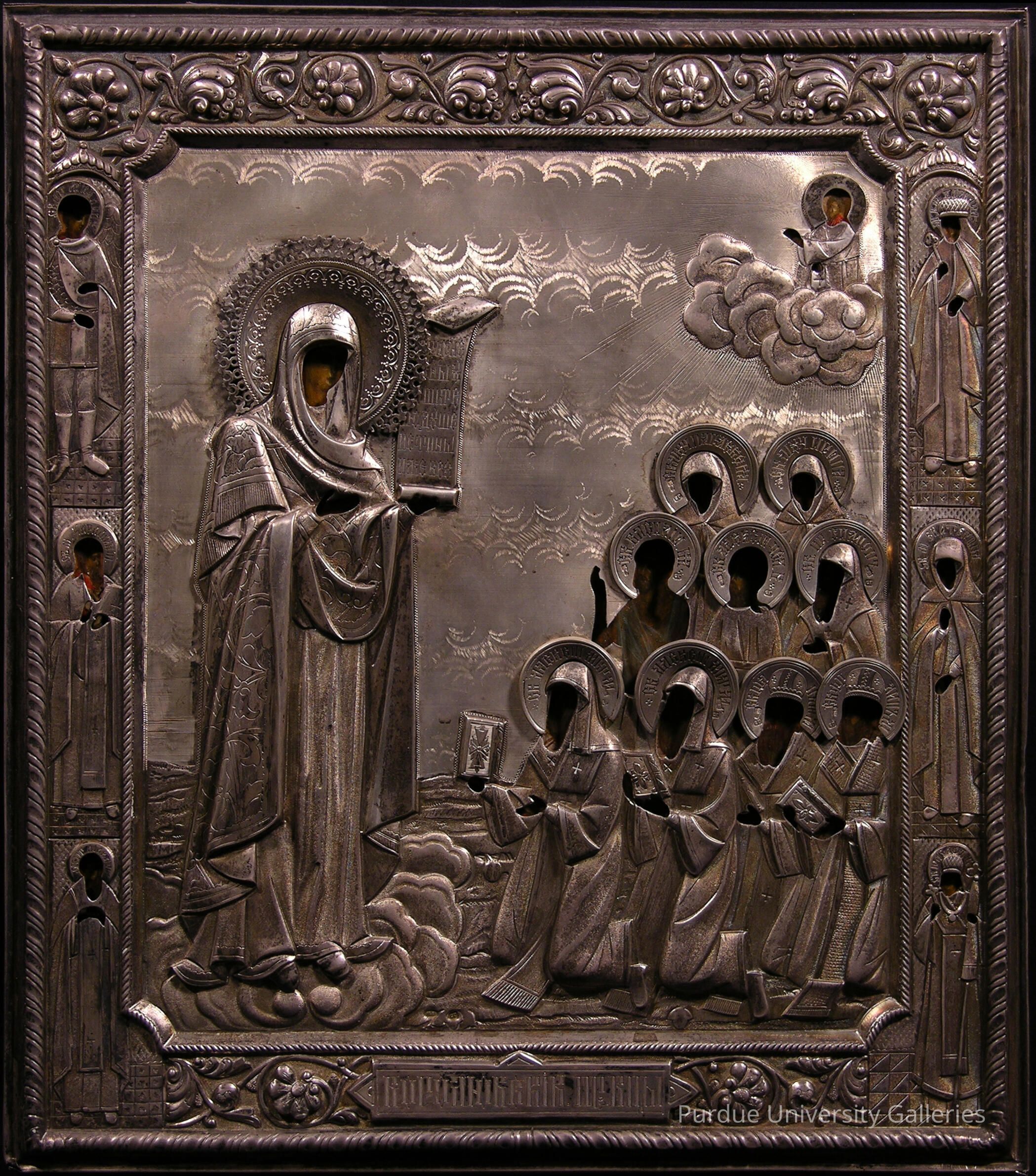
Bogoliubskaya Mother of God, The
2005.02.028
Panel
Betsy Scheuring Icon Collection
2005.02
Betsy Scheuring
Gift
Gift of Betsy Scheuring
1875 - 1900
19th Century
Moscow, Russia
Makers Mark
Bottom of the main image, just above the caption and below the clouds at Mary's feet, in Mary's halo, in every halo of the saints pictured on the right
СГ, 84 with crowned head symbol
Cyrillic
SG
Unknown artist but other paintings in Finland
Inscription
Back of icon
Typed summary of piece (English) and unintelligible cursive in pencil
Icon
Symbol, Religious
Religious Objects
Ceremonial Objects
Category 08: Communication Objects
14 in
12-1/4 in
1-1/2 in
Spirit Made Tangible: The Scheuring Icon Collection (2006)
Cultural/Historical Context
The Bogolyubov Mother of God refers to the story of the dream of Grand Prince Andrei Georgievich Bogolyubsky after his victory in the battle of Kiev in 1157 (see 2005.02.068) He saw the Mother of God standing full-length and holding a scroll, looking at Jesus in the clouds. She told him to have her image placed in a church in the city of Vladimir, and accordingly a church was constructed and the icon painted. The latter-day celebration of the icon was instituted in 1771, when it was credited with saving Kiev from a disastrous plague. The “Moscow” version of this type adds a group of saints to the original scene, including nine figures who kneel before her. The scroll is inscribed with the words: “Ruler most gracious, Lord Jesus Christ, my son and my God, hear the prayer of your Mother, for she prays for the world.” The raised border has a floral pattern and includes six figures of family saints, or saints with particular importance to the patron. The figures vary in scale, with the Virgin appearing much larger, in a monumental vision. Christ is shown much smaller, as another vision farther away in the sky. These effects lend an otherworldly atmosphere to the scene, underscoring the contemplative purpose of the icon.