A Historian’s Place in the Laboratory
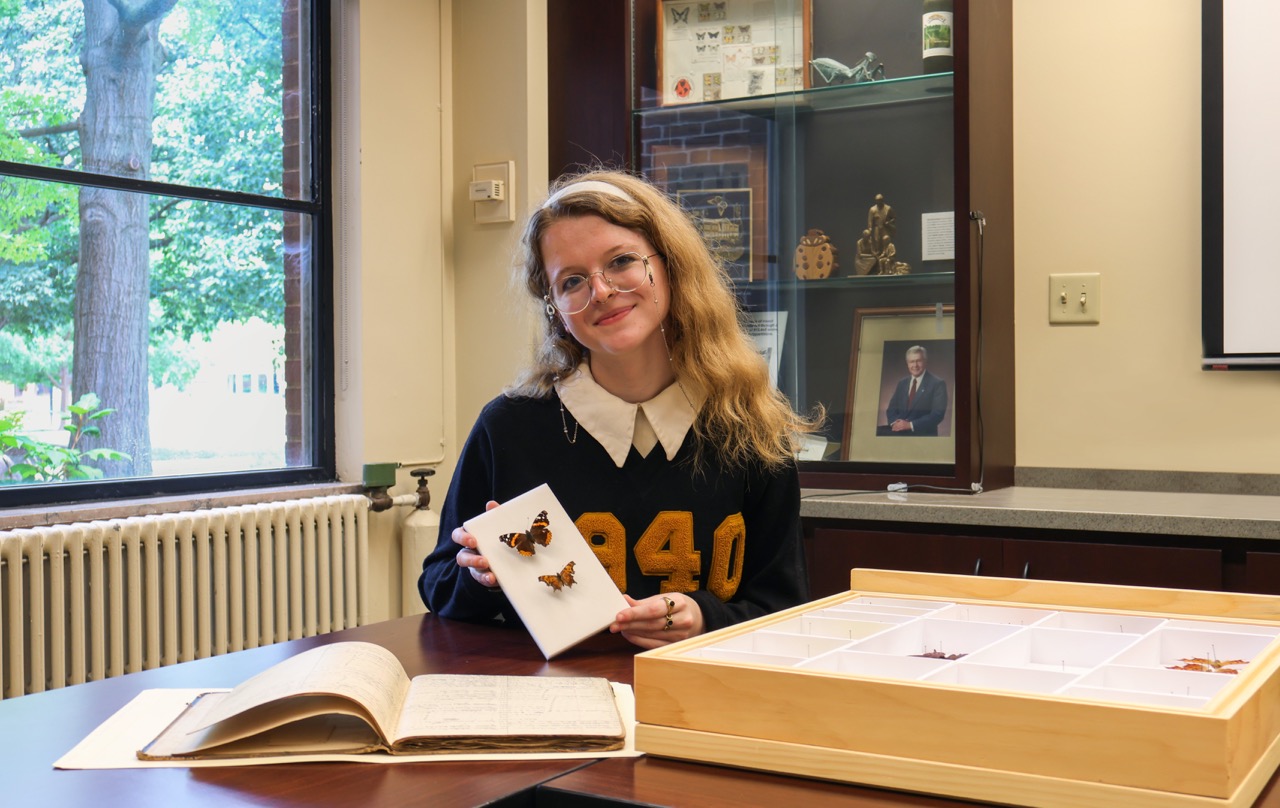
Growing up in southern Indiana, Rice had long been interested in both insects and history, even participating in historical reenactments. She came to Purdue knowing she wanted to combine those interests but wasn’t sure how they fit together.
Then, while registering for classes for her first semester, she spotted a 300-level history of biological science course.
“It made sense to me finally how history and science were connected,” Rice said. “I just fell in love with that niche.”
Rice is a Degree Plus student who studies history and history of science, technology and medicine with a minor in museum and archives studies and a medical humanities certificate in Purdue’s College of Liberal Arts, alongside insect biology in the College of Agriculture. She plans to pursue graduate school in the history of science, technology and medicine and ultimately build a career helping people better understand not only what scientists discover, but the history that shapes those discoveries.
It’s a perspective Rice has developed throughout her time in CLA.
Looking beyond the discovery
In history of science, technology and medicine courses, Rice and her classmates don’t simply study scientific breakthroughs. They examine how scientific ideas developed, the people and circumstances that shaped them and how those histories continue to influence society.
For Rice, studying that history has changed how she approaches science itself.
She sees the difference now in her insect biology lab, where she works with DNA extraction, amplification and sequencing. Rice knows how to use the technology, but her history coursework pushes her to think beyond the procedure.
“I can think about them more comprehensively in an intellectual way,” she said, “knowing the decades of progress that it took to get to the technology I’m using to make scientific discovery.”
Studying liberal arts at a university known for STEM has only strengthened that perspective.
“While it might seem a little curious to go to a STEM school to study liberal arts, I find it’s been one of the best things for me to be able to interact with people in STEM and talk about history,” Rice said. “It’s helped me sharpen my skills in communicating history and helped me form my own interdisciplinary connections.”
One of those connections can be found in thousands of letters housed at Purdue.
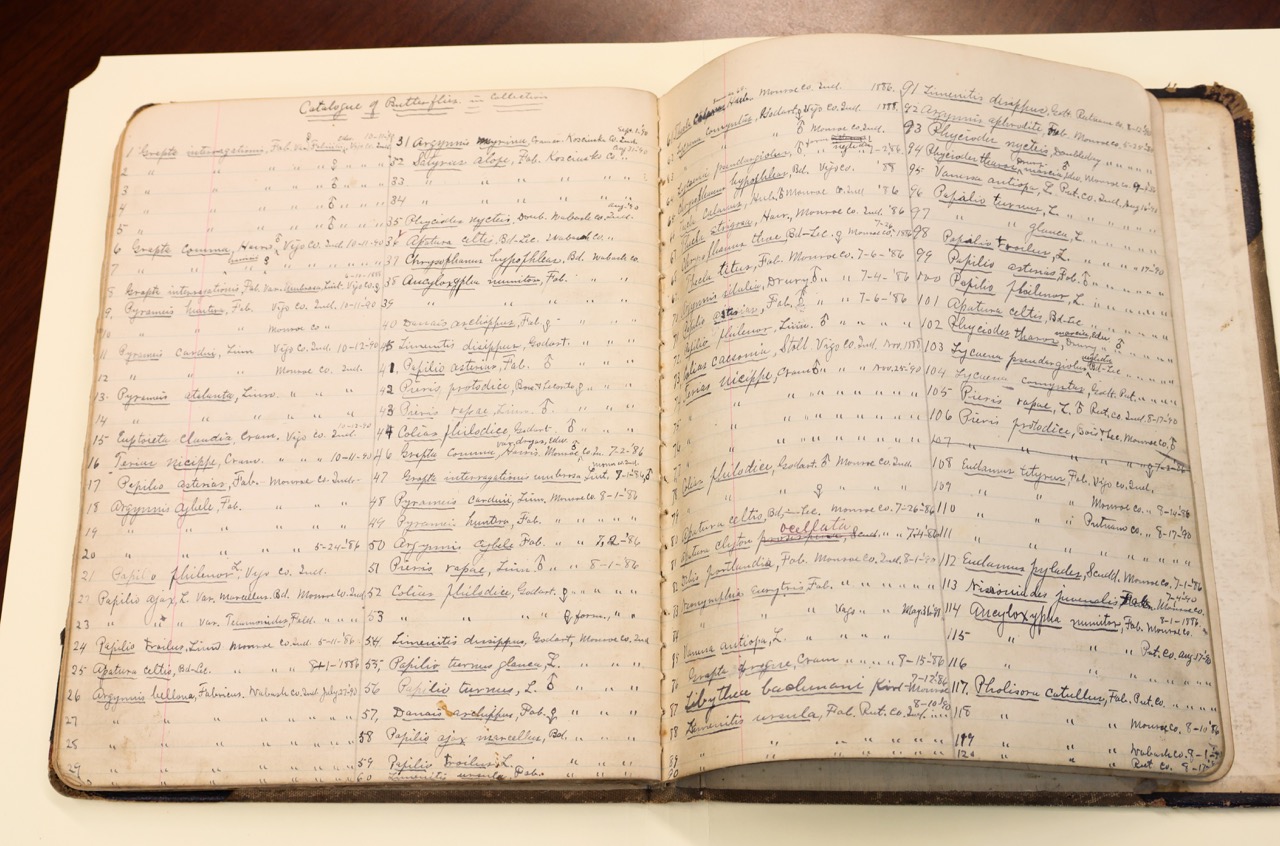
For several years, Rice has worked with the Purdue Entomological Research Collection, which holds specimens associated with Willis Blatchley, an influential entomologist and former Indiana state geologist. Along with those specimens came thousands of letters.
Rice has taken on the historical side of the collection, inventorying, organizing and transcribing the correspondence so researchers can better understand the context surrounding specimens that are still used in biodiversity research today.
A detail in a century-old letter can add meaning to a specimen used by a scientist generations later.
The project “so clearly illustrates the connection between science and history and the value that science and history give to each other,” she said.
From an interest to a career
Rice has continued exploring that connection well beyond Purdue’s classrooms.
Her undergraduate thesis through the history honors program led to research at Cold Spring Harbor Laboratory in New York and the American Philosophical Society in Philadelphia. She also worked with historical scientific collections in the Czech Republic, researching the histories and provenance of objects ranging from entomological collections to medical models.
Her path received another boost this year when she was named one of only 16 recipients of the Beinecke Scholarship, a national award supporting students in the arts, humanities and social sciences who plan to pursue graduate education.
“Growing up as a first-gen low-income student, graduate school felt so far out of reach, and now Beinecke has given me that opportunity.”
Now she plans to pursue graduate education in the history of science, technology and medicine, with an eye toward a career in academia or museums.
And the goal she describes sounds a lot like the connection she first discovered in that Purdue classroom four years ago.
“I want to work with scientists so they can better understand the history of what they’re doing in the lab, and with the public so they can better understand the implications of the history of science in their daily lives,” Rice said.
For Rice, understanding where science has been isn’t separate from thinking about where it goes next.
Students of the arts, humanities and social sciences interested in applying for the Beinecke Scholarship may contact Purdue’s National and International Scholarships Office.