Cognition, Agency, & Intelligence
ABOUT US
The Cognition, Agency, and Intelligence Center (CAIC, pronounced “cake") uses cutting edge cognitive science to understand different kinds of intelligent agents and the real-world consequences of their actions.- Cognition: thinking, learning, and other forms of high-level information processing
- Agency: acting, initiating and taking actions in the pursuit of specific aims and outcomes
- Intelligence: using cognition to act successfully
Cognitive science is inherently interdisciplinary. Cognitive scientists recognize that minds may be realized in a range media, and are well-equipped to study their capacities in any of the variety of forms they might take, both natural and artificial. CAIC fosters the interdisciplinary study of thinking, action, and intelligence in all their diverse forms.
CAIC Speaker Series
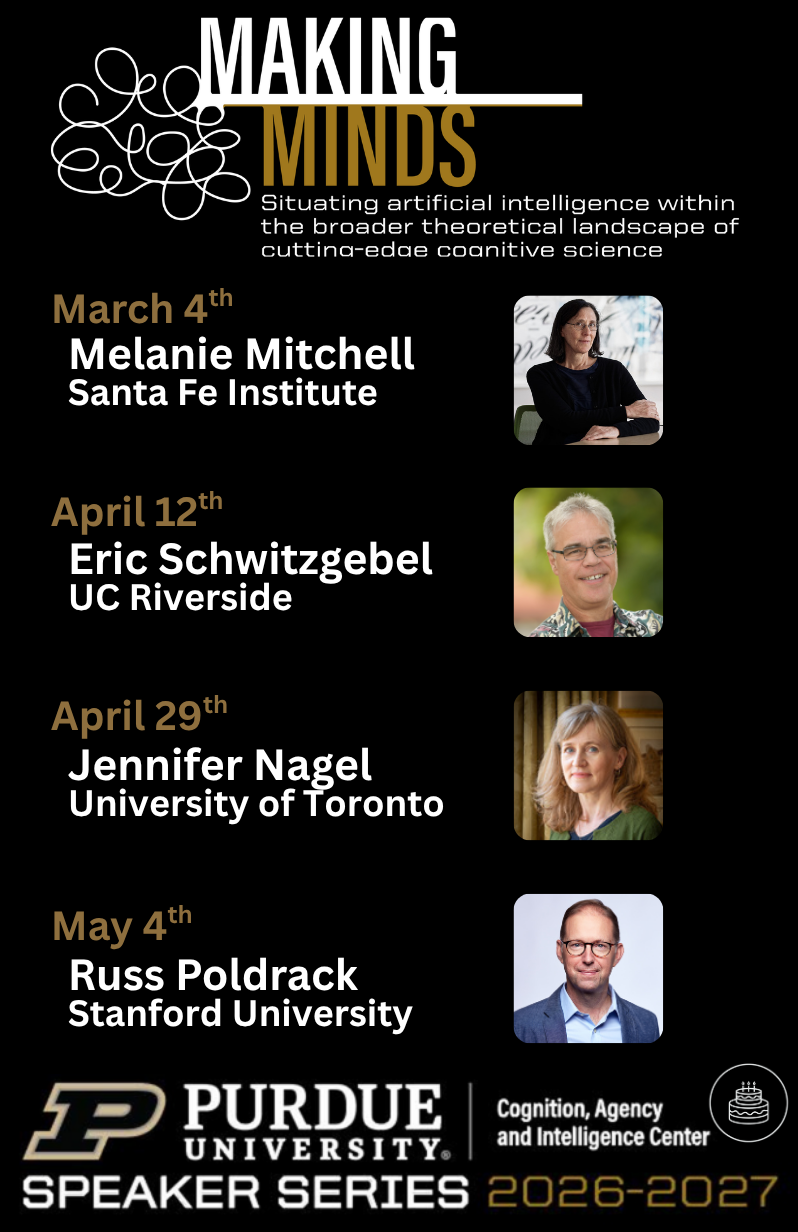
CAIC 2026-2027 Speaker Series: “Making Minds”
We are excited to announce the lineup for our inaugural season of the CAIC Speaker Series. This year’s theme is “Making Minds: Situating artificial intelligence within the broader theoretical landscape of cutting-edge cognitive science”. These talks will be open to the public, and promoted to the entire Purdue community…Mark your calendars now and be part of the conversation.
Launch Event
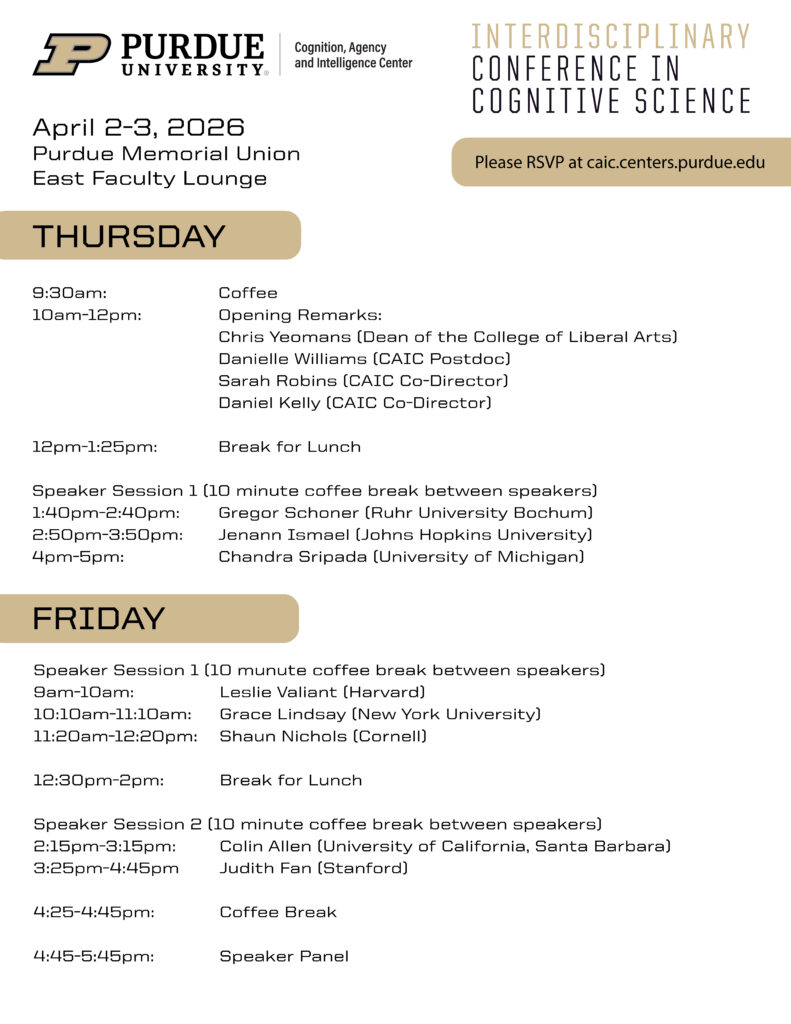
Watch the Launch Event Talks!
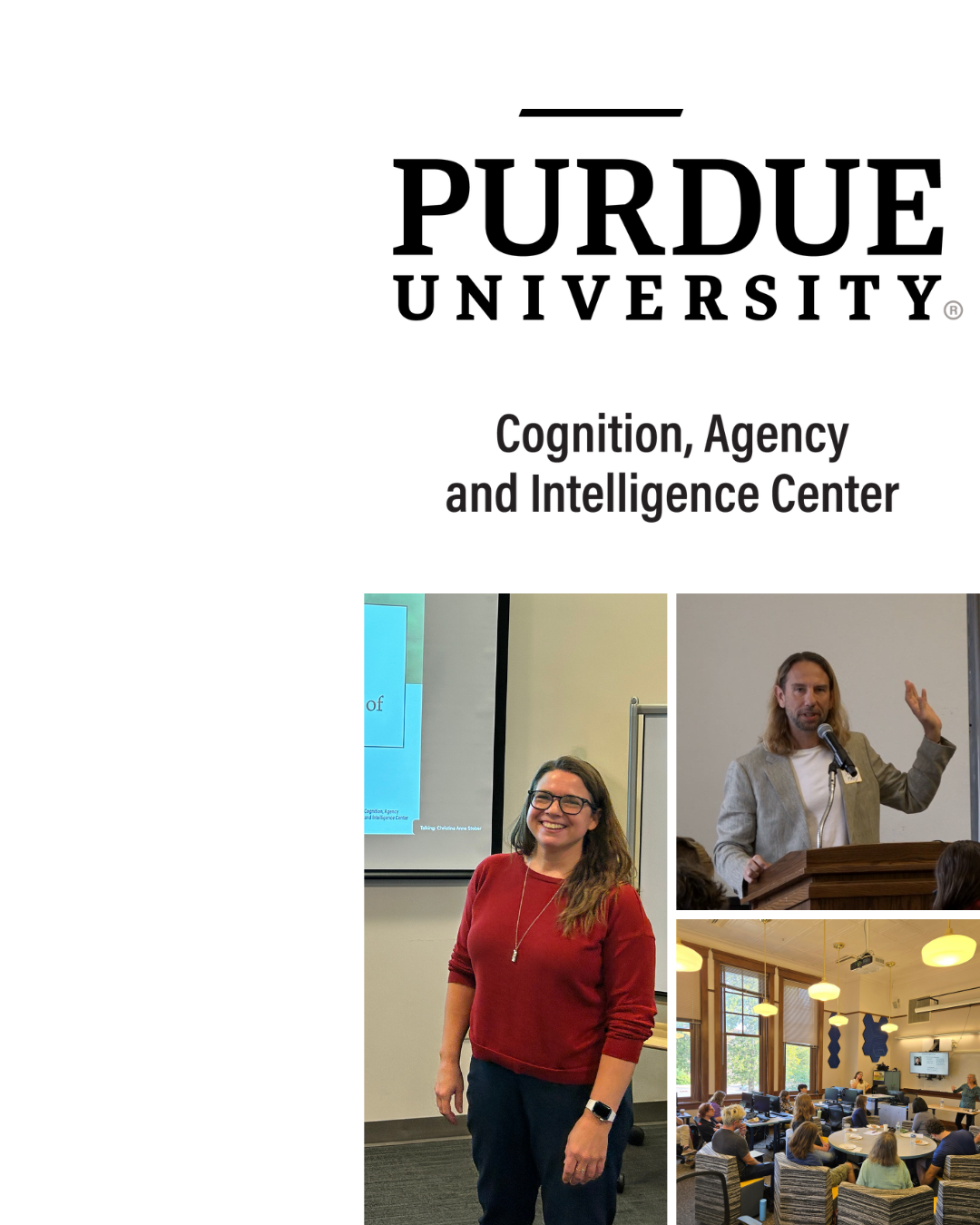
Our launch event was a hit! Check out the opening remarks below:
See the full series of videos here.
You can also follow us on:
 |
 |
 |
LIEBOWITZ AWARD

CAIC Co-Director Sarah Robins receives 2026 Lebowitz Prize
Sarah Robins, professor of philosophy in Purdue’s College of Liberal Arts, has been named a recipient of the 2026 Dr. Martin R. Lebowitz and Eve Lewellis Lebowitz Prize for Philosophical Achievement and Contribution.
Awarded annually by the Phi Beta Kappa Society in conjunction with the American Philosophical Association, the Lebowitz Prize recognizes outstanding achievement in philosophy. Unique in its design, the award is jointly conferred on two philosophers who hold contrasting perspectives on a topic of contemporary significance. Robins shares this year’s honor with co-winner Felipe De Brigard, professor of philosophy, psychology and neuroscience at Duke University.
Robins and De Brigard will present their work and engage in public dialog on “The Distinctiveness of Memory” at the annual Lebowitz symposium at the American Philosophical Association Pacific Division meetings in March 2027. Related papers appear in Space, Time, and Memory (2025, eds Nadel and Aronowitz, Oxford University Press): “A Place for the Memory Trace,” (Robins) and “Simulationism and Memory Traces” (De Brigard).
Read the full story here.
SPP President

CAIC Co-Director Dan Kelly is the new President-Elect for the Society of Philosophy and Psychology
Over the summer, Daniel Kelly was elected President-Elect of the Society for Philosophy and Psychology (SPP), one of the premier scientific and educational organization for philosophically interested psychologists and psychologically interested philosophers in North America.
He will become the SPP’s 54th President in 2027, and will help continue its mission of promoting interaction between philosophers, psychologists and other cognitive scientists on issues of common concern. The 50th anniversary meeting of the SPP was hosted by Purdue University in June 2024.
New Cognitive Science major
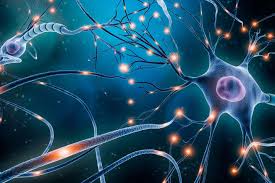
New Cognitive Science Major
The brand new Bachelor of Arts degree in Cognitive Science is a comprehensive and interdisciplinary program designed to explore the intricate workings of the human mind and intelligence. Through a combination of philosophy, psychology, computer science, biology, linguistics, behavioral economics, and more, this program offers students a unique opportunity to delve into the mechanisms underlying perception, learning, memory, decision-making, language, and problem-solving.
Artificial Intelligence major
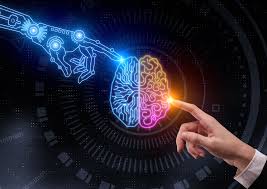
Artificial Intelligence Major
Human and machine interactions are evolving fast — just ask Siri or Alexa. With a Bachelor of Arts degree in artificial intelligence (AI), explore how technology, big data and AI are shaping the world — and what it means to build technology responsibly. If you’re drawn to big questions and proficient in calculus, this major lets you dive into issues like privacy, bias and the ethics behind algorithms while gaining programming and data skills employers want. Blend computer science with eight specialized philosophy courses to build a strong technical foundation and a deep understanding of the human side of AI.