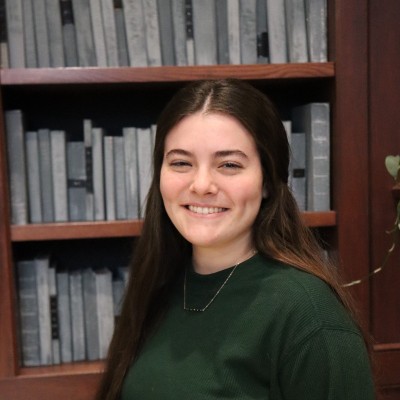
Celia Hart
Majors: Political Science, History
Contracts Administrative Support & Automation Intern at Defense Logistics Agency
How did you learn about this internship opportunity?
I found the opportunity on Handshake listed under the DCAIP Program. DCAIP is short for Department of War College Acquisition Internship Program.
What is a piece of advice you would give someone in your major looking for an internship?
Be open to any and all opportunities. The benefits of Liberal Arts degrees, especially combined with degrees from other academic colleges, can be applied in nearly every field. Your perspective and experience are unique, and as you build your professional career, those only become more valuable. Be willing to try anything. You won't know if you do or do not enjoy something if you aren't willing to try.
What key responsibilities or projects have you taken on during your internship?
Throughout my internship, I experienced a variety of responsibilities and projects. For context, I served in the Utility Services Division under the Utilities Privatization umbrella. Our division is unique in that our contracts are live for fifty years with a high potential for re-signing, as we are selling the infrastructure on U.S. military bases to private businesses to maintain and improve to support warfighting capabilities. On the daily, I attended meetings regarding multiple bases and utility systems across the country, including California, Hawai'i, and North Dakota. These meetings included our DLA team, relevant military officials, and the System Owners (private businesses who maintain the utility service systems). I would take notes, reflect, and pose questions for following meetings. Additionally, I provided a majority of support through research when issues arose. Each contract, base, and system is unique, which provided a multitude of opportunities to research a variety of topics. Further, I provided support by composing modifications for contracts. Some of the modifications were annual practices, while others were high-paced rollouts due to Executive Orders from the federal government. However, the main goal of my attendance and participation with these unique contracts was to understand the business processes within the unit. The main assignment I had was to propose, create, and execute tools to improve said processes within the unit. I proposed five different solutions, with two prevailing. These projects became the major points of work for the last seven weeks of the internship. First, I built an artificial intelligence agent to assist in the training and onboarding of division employees. The training and processes folder contained over 1,500 documents--an overwhelming amount to sift through, whether you had been a part of the division for twenty days or twenty years. To create the agent, I organized content into specific sub-folders and then identified key language used throughout the documents. Using this key language and the documents available, I wrote descriptions and instructions for different sub-agents to specialize in certain content. Lastly, I created a "central" agent that would take in the user's inquiry and delegate it to the proper sub-agent(s). I used the Gemini Enterprise system to create the agent. Second, I built an invoice processing automation system. While the Department of War has its own payment portals, division employees need to track the invoices relevant to their contract and utility system. The accuracy and consistency of this tracking needs to be nearly perfect, as this content is present as a back-up and will follow the contract for its fifty-year duration. Throughout my time with contract specialists in the division, I noted that they were still inputting these fifteen column entries manually, taking up to five minutes per line of invoicing. While it does not sound like a lot, some of these contracts have up to one-hundred lines of invoicing per year. The time adds up, and it wastes time the division needs to support the warfighter. Using Query in Excel, I created a system that would read raw invoicing data, clean it, and sort it appropriately. This five-minute process was slimmed down to fifteen seconds and saves the division over fifty workdays of time annually.
How has your internship helped build your skills and clarify your career goals? How did being a Liberal Arts student at Purdue apply to your internship?
In the most positive way, this internship showed me what I absolutely do not want to do, while showing me exactly what I do want to do at the same time. I had a blast with the pure contract support pieces, such as attending meetings, completing research, and working with specialized teams. On the other hand, I disliked the technological development piece of the position. Once I began the internship and learned of the automation project requirements, I truly questioned why I was selected for the role. My resume is clean and honest--I have virtually zero technical experience outside of the Microsoft Suite. However, I learned how to have fun with the massive learning curve. It was a brand-new environment with brand-new skills required, and my team provided all the support I needed and more. One of the biggest pieces, beyond the technical aspect, was learning how to understand and breakdown the processes I needed to help automate. While the link may not seem direct, my studies within liberal arts best prepared me for this part of the process. My political science and history courses have taught me how to look at an issue, identify the actors, causes, effects, and just about everything else. My ability to fully break down these processes and build tools in response to them were rooted in the skills I learned from my liberal arts courses. The interdisciplinary background of my studies were the most critical to me understanding the tasks I was assigned, how to analyze them, and how to execute them in ways that were accessible for a division of nearly two-hundred people. Beyond overcoming the learning curve, this internship helped to solidify my interest in administrative/contract law. My supervisors did a wonderful job providing me with opportunities to interact with law-based issues as often as possible, even setting up a meeting with Senior Counsel so that I may better understand those who legally support our division. Additionally, the tasks I was assigned could always be expanded upon, and I did my best to do so, especially in the cases in which I had an interest in the issue. I found I truly enjoyed diving down the rabbit hole and analyzing all possible causes and solutions. While I had a rollercoaster of an experience, this internship taught me how invaluable the interdisciplinarity of the liberal arts education is and how deeply I desire to understand issues and create solutions in ways that are well-researched and well thought-out.
In what ways has the College of Liberal Arts at Purdue University supported your internship journey? How has your participation in our Job-Ready program specifically aided your professional development?
As I have sought out internship opportunities relevant to all three of my majors, the College of Liberal Arts has done a wonderful job of alerting me to the variety of opportunities available and the support networks that exist to help me achieve those goals. While I completed my internship search mostly independently, those around me in CLA provided an abundance of support and advice. At least once a semester, the career advisors appear in minimally one of my courses, alerting us to the support and opportunities available through the career office. Ironically, those classroom presentations came around the time I was truly lagging in my internship search. Hearing about the Job-Ready program and how it would be able to support an internship I sought reinvigorated my search. It opened a number of doors knowing that there was expense-based financial support available for those who worked for it. All of the opportunities I ended up applying for would require some form of relocating for the summer, and the Job-Ready program assisted with that. While Fort Belvoir was only sixty miles from home, the commute one-way would likely be two or more hours every day. The Job-Ready program granted me the ability to relocate to a twenty-minute commute location for the summer. Besides convenience, this meant I was able to show up to work with an energy and excitement each day that I would not have had after a four-hour, round-trip commute. The support of the College of Liberal Arts and the Job-Ready program equipped me with the necessary support that I needed to further my professional development in a new role. By expanding the geographical circle I could explore in, I was able to find a unique opportunity that taught me an abundance of technical, interpersonal, and professional skills.
Could you highlight a standout aspect of your experience in the Job-Ready program that you find particularly noteworthy?
The best gateway the Job-Ready program provided me with was the opportunity to work with my team at the Defense Logistics Agency this summer. They were truly the absolute highlight of the entire internship experience, and I would not have had a chance to work with them if it had not been for the financial support of the Job-Ready program. The team was not only welcoming, but beyond supportive, encouraging me to pursue my passions and providing advice where at all applicable.