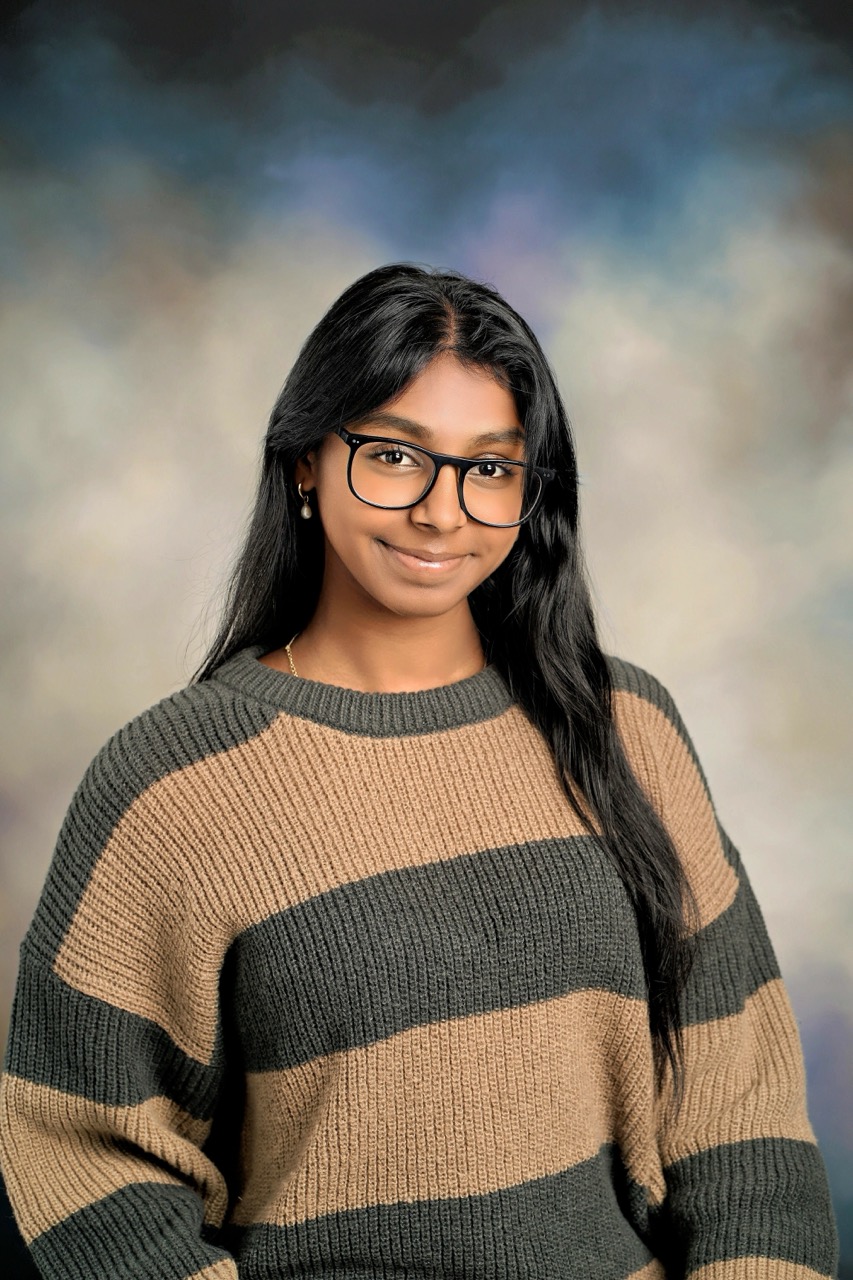
Nidhi Kirani
Majors: Anthropology (B.A.), Electrical Engineering (B.S.)
SRC Scholar/ NSF REU Intern at National Science Foundation
How did you learn about this internship opportunity?
Research Mentor
What is a piece of advice you would give someone in your major looking for an internship?
Don't wait until you feel "qualified enough" to apply. Many research internships value curiosity, persistence, and a willingness to learn just as much as technical experience. Reach out to professors whose work genuinely interests you, attend research events, and don't be discouraged by setbacks. Once you get into a lab, ask questions, volunteer for new tasks, and embrace troubleshooting—research rarely works perfectly the first time, and learning how to solve problems is one of the most valuable skills you can develop.
What key responsibilities or projects have you taken on during your internship?
During my NSF REU internship with the InSPIRES program, I worked on a semiconductor fabrication project focused on developing gold microelectrodes for a PDMS-based microfluidic platform to help differentiate breast cancer cells based on GLUT5 expression. My responsibilities included fabricating microelectrodes using photolithography, thin-film deposition, lift-off, and metal etching techniques, as well as optimizing fabrication parameters such as photoresist selection, spin speed, and UV exposure time. I also characterized fabricated devices using optical microscopy, profilometry, and a tabletop scanning electron microscope (SEM) with energy-dispersive spectroscopy (EDS) to evaluate pattern quality and material deposition. Throughout the project, I documented experimental results, analyzed fabrication failures, presented my findings through technical presentations and a research poster, and collaborated closely with faculty mentors and fellow researchers to iteratively improve the fabrication process.
How has your internship helped build your skills and clarify your career goals? How did being a Liberal Arts student at Purdue apply to your internship?
This internship gave me my first in-depth experience working in a semiconductor fabrication environment and significantly expanded both my technical and professional skills. I learned cleanroom fabrication techniques, including photolithography, metal deposition, lift-off processing, and device characterization using advanced instrumentation such as SEM, EDS, and profilometry. More importantly, I learned that successful research depends on systematic experimentation, careful documentation, and persistence. Many of our fabrication attempts did not produce the expected results, but each iteration taught us something about how process parameters affected device performance. The experience also strengthened my ability to read scientific literature, communicate technical findings, and present research to both technical and non-technical audiences. Working closely with graduate students and faculty gave me a much better understanding of how interdisciplinary research teams solve complex engineering problems. Most importantly, this internship confirmed my interest in semiconductor manufacturing and hardware research. Seeing how microfabrication techniques can be applied to biomedical challenges demonstrated the exciting intersection between electrical engineering, materials science, and healthcare. It reinforced my desire to pursue future research opportunities and eventually build a career developing advanced semiconductor technologies. Although my primary field is engineering, my Liberal Arts coursework at Purdue played an important role throughout the experience. Strong writing and communication skills helped me prepare technical reports, create research posters, explain complex fabrication processes, and collaborate effectively with researchers from different disciplines. The ability to clearly communicate technical ideas is essential in research, and my Liberal Arts education helped me become a more effective engineer by strengthening my critical thinking, communication, and presentation skills.
In what ways has the College of Liberal Arts at Purdue University supported your internship journey? How has your participation in our Job-Ready program specifically aided your professional development?
The College of Liberal Arts helped me develop the professional skills that complemented my technical engineering education throughout my internship. Through the Job-Ready program, I strengthened my resume, practiced interviewing, and learned how to effectively communicate my experiences to employers and research mentors. Those skills gave me greater confidence when applying for research opportunities and discussing my work with faculty and industry professionals. Throughout my REU, I realized that research is about much more than technical ability. Success also depends on communicating ideas clearly, working collaboratively, adapting to unexpected challenges, and presenting results in a meaningful way. My experiences as a CLA student reinforced these transferable skills, allowing me to contribute more effectively within an interdisciplinary research environment. The combination of technical knowledge and strong communication skills has prepared me to be a more well-rounded engineer and researcher.
Could you highlight a standout aspect of your experience in the Job-Ready program that you find particularly noteworthy?
The most valuable aspect of the Job-Ready program was learning how to communicate my experiences with confidence. It helped me move beyond simply listing technical skills on a resume and instead explain the impact of my research, the challenges I overcame, and what I learned from the experience. Those communication skills proved invaluable throughout my REU, whether I was discussing my work with faculty mentors, presenting my research poster, or networking with other researchers.